 LBM
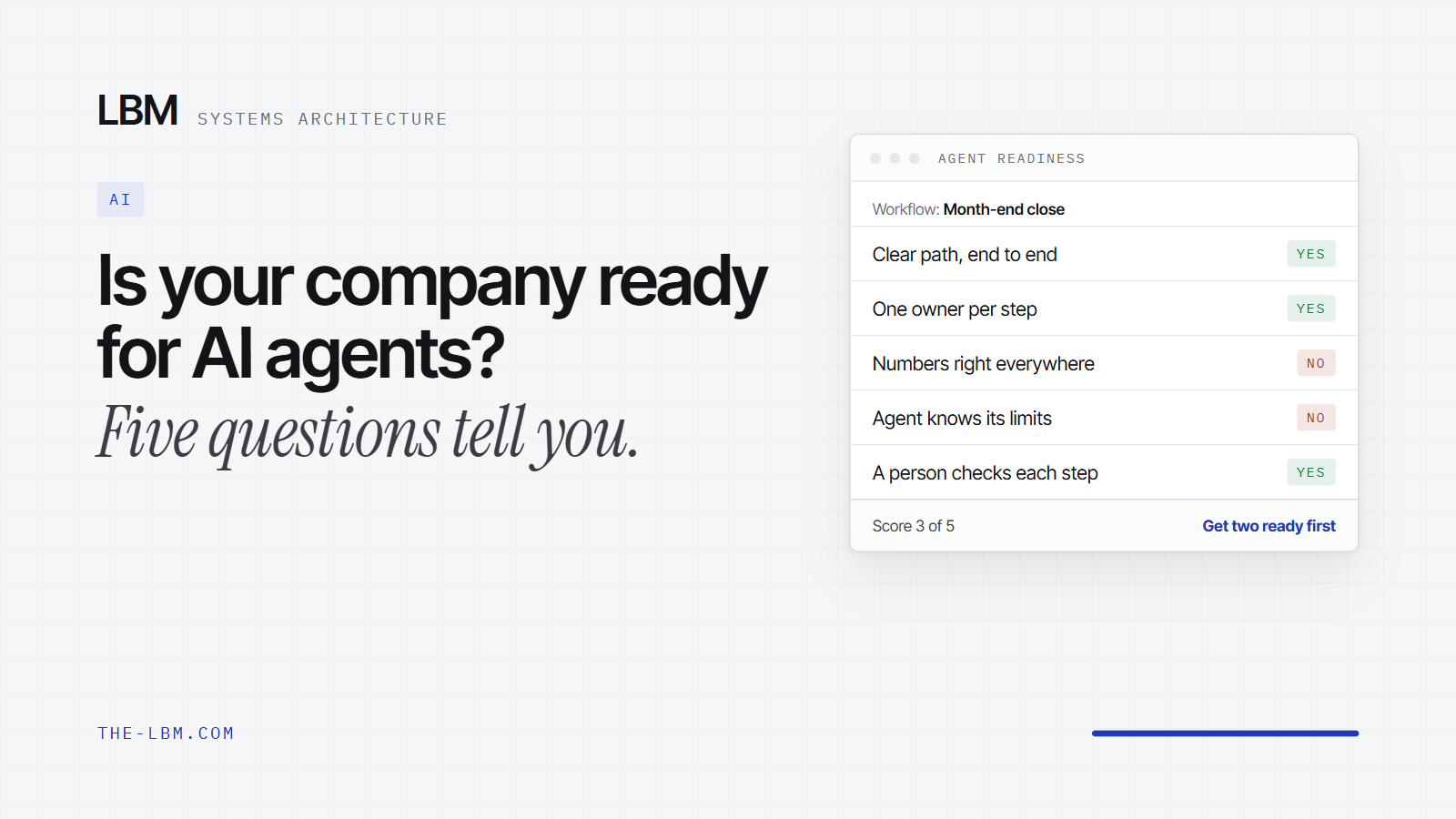
Probably not yet, and that is fine. Five questions tell you where the gaps are. If you answer no to two or more for the workflow you want to automate, agents will scale the gaps, not your output. The fix is to get that one workflow ready first: a clear path, an owner for each step, numbers you can trust, clear limits, and a person checking, before any agent touches it.
Your board is asking. Your competitors are posting about it. Someone has sent you the article about the CFO who runs finance with agents. And quietly, you sense that the company is not set up for agents yet.
You are not behind. You are reading the situation correctly.
The Dell story is real. As Fortune reported in March 2026, Dell's CFO uses AI agents across his finance team. But the headline misses the lesson. The agents work inside an environment that was standardised first. That is the real prerequisite, and it is where most companies are not yet ready for AI agents.
Why is being ready for AI agents a systems question?
Most AI conversations start with the tool. Which model, which vendor, which platform. That is the wrong layer.
The research agrees. When BCG asked 1,000 senior executives what gets in the way of AI, about 70% of the problems came from people and process, 20% from technology and only 10% from the algorithms (BCG, October 2024). McKinsey's latest survey points the same way: among the few companies that get real financial results from AI, nearly three quarters have fundamentally redesigned their workflows, against one quarter of everyone else (McKinsey, August 2026).
An agent does exactly what the workflow around it allows. If the workflow is clear, it moves faster. If the workflow depends on what a few experienced people know, the agent cannot see it, and has nothing to stand on. This is the same reason companies that run on people rather than systems struggle to scale: the logic lives in heads, not in the structure.
The people who build the models found the same thing. When Anthropic let its own model, Claude, run a small shop in its office, the agent sold items below cost, was talked into discount codes and for a while told customers to pay into an account that did not exist (Anthropic, June 2025). Anthropic's own reading: many of the mistakes came from missing structure around the model, such as better tools, a customer record and memory, rather than from the model alone.
So the five questions below are not about AI. They are about the workflow you want AI to work in. Each one tests one layer of the base AI needs: a clear path, an owner, the right numbers, clear limits, and a check.
Which five questions show whether you are ready?
1. Can someone show how the work flows, end to end, without saying "it depends"?
If the workflow has hidden exception paths, undocumented handoffs, or steps only one person knows how to do, an agent will not handle them. It will invent a path, stall, or escalate everything. A clear path is the floor; everything else builds on it.
Anthropic's guide for engineers, Building effective agents (December 2024), draws the same line. A workflow follows a predefined path; an agent directs its own steps. The advice is to use the simplest solution that works and add agents only when simpler set-ups fall short, with checkpoints where a person reviews the work. You can only choose the simple path if you know what the path is.
2. Does each step have one person who owns it?
"Everyone is responsible" means nobody is. When the agent produces an unexpected output, who decides what happens next? If you cannot name one person per step, you do not have ownership. You have a meeting waiting to happen.
3. Are the numbers right, and the same everywhere?
Agents inherit the quality of their inputs. If three teams use three definitions of the same field, or critical data lives in a spreadsheet someone updates by hand, the numbers have not yet caught up with how the company has grown. You are not alone in this: 63% of organisations either lack or are unsure they have the right data management practices for AI (Gartner, February 2025).
This is where it gets worse than most people expect. A person who meets a broken field knows it is broken. Years of experience tell them the number is wrong, so they check it or ignore it. A model does neither. It predicts. When it does not know, it assumes, and it presents the assumption with the same confidence as a fact.
So the failure is not that the agent stalls. The failure is that it answers, fluently and plausibly, from bad inputs. Connect an assistant to a CRM where pipeline stages are used differently by three teams and you will get a clean, well written, entirely wrong answer about your own funnel. Nobody catches it, because it reads like the truth.
4. Does the agent know its limits and the context it works in?
What can the agent prepare, and what needs a person to approve? What is never automated? What does it need to know about how your company works? If these answers live in people's heads, every output escalates, the team starts re-checking everything, and the speed you paid for disappears.
This is also how the models work best. Anthropic's engineers describe a model's context as a finite attention budget (Anthropic, September 2025): an agent does best with the smallest set of high-value information, plus notes it keeps outside the conversation. A company that can say clearly how it works can give an agent exactly that.
5. Can a person see every step, check it and undo it?
Can you see what happened, why, and who can undo it? Finance, compliance and operations will reject any system that cannot answer this. If the audit trail is bolted on after launch, it fails in the first incident, which is exactly when you need it most.
There is a technical reason too. Security researcher Simon Willison calls it the lethal trifecta (June 2025): an agent that can read your private data, sees outside content such as emails or web pages, and can send messages out can be tricked into leaking that data, and no guardrail product stops it every time. Which tools an agent gets, and where a person approves, is a design decision, not a setting.
This is the gap the market is walking into. By 2030, 42% of companies expect to give AI agents real decision-making authority, yet only 5% have the full set of controls in place today (BCG, September 2026). In the work I do, the agent prepares and a person approves, with a record of every step.
What do your answers mean?
| Score | Reading | What to do next |
|---|---|---|
| 5 yes | You are ready | Pick a high-volume workflow and pilot it. Measure honestly. |
| 3 to 4 yes | You are close | Fix the missing layers on that one workflow first, then pilot. |
| 2 or fewer | Do not automate yet | Agents will speed up what is not ready yet. Start with the workflow, not the vendor. |
There is no version of this where you skip the groundwork. The companies whose AI holds up in production did the boring part first.
Why do most AI programmes stall at this point?
The pattern is predictable. A CEO announces an AI initiative. Tools get bought. A pilot runs. The demo works. Then it meets the messy middle of the business: edge cases, exceptions, missing inputs, unclear approvals, data that does not reconcile across systems. The AI programme gets the blame. In truth, the company has outgrown the way that workflow runs, and the AI made it visible.
Agents do not fix a workflow that is not ready. They scale it. Ambiguity becomes machine-speed ambiguity. Inconsistent data becomes confident inconsistency. Unclear ownership becomes a trust problem, which forces people to re-check everything, and the benefit evaporates. The company ends up paying for automation while still living with the original bottlenecks.
If your rollout has already happened and the results disappoint, the AI readiness check shows which of these layers is missing. It is the same trap described in startup scaling with systems: adding capacity before the way the company runs has caught up with its size scales the strain, whether the capacity is people or software.
Where should you start?
Most AI programmes fail because they start broad. They become political. They become a dashboard nobody trusts.
What works is a narrow wedge. Pick one workflow where automation would create real value, and make it ready before any agent touches it.
Common candidates:
- Month-end close and reconciliations
- Forecasting and variance tracking
- Order-to-cash exception handling
- Invoice and payment matching
- Onboarding and access provisioning
The first result is not an agent. It is a workflow the business can run consistently, with clear inputs, clear outputs, a named owner, written limits on what can be automated, and a record of every step. Once that exists, automation becomes an engineering decision. Until then, it remains a leadership and process problem.
That is the part I work on. I do not build or sell AI. I build the base AI works on, one workflow at a time, with your team, so whoever builds the agent has something solid to build on.
When does this question become urgent?
The models will not wait for you. Research group METR measured that the length of tasks AI agents can complete doubled roughly every seven months over the six years to March 2025. Capability is no longer the bottleneck. The base is.
Ask it now if any of these are true:
- Your board or investors want to know your AI plan and you need an answer you can defend
- Teams are pushing to "implement agents" but you sense the foundation is not there
- An earlier AI pilot underperformed and you do not know whether it was the tool or the workflow
- Finance, compliance or risk has raised concerns about automated decisions
- You want AI leverage but cannot afford AI risk
If two or more apply, the readiness question comes before the vendor question.
Questions people ask about AI agent readiness
What does it mean for a company to be ready for AI agents?
The workflow the agent will work in is clear end to end, each step has one owner, the numbers are right and the same everywhere, the agent knows its limits and context, and a person can check and undo every step.
Why do AI agents give confident answers from wrong data?
A model predicts rather than checks. If three teams define the same field three ways, it picks one and presents the result as fact. A person would notice that the number looks wrong. The model will not.
Is it the AI model or the process?
Rarely the model. In BCG's 2024 survey of 1,000 executives, about 70% of AI problems came from people and process and about 10% from the algorithms. McKinsey's 2026 survey found that the companies getting real results are about three times as likely to have redesigned their workflows.
Which workflow should we make ready first?
One with high volume, clear inputs and a cost of delay you can measure, such as month-end close, invoice matching or order-to-cash exceptions. Make that one workflow ready before any agent touches it.
Our AI pilot underperformed. Was it the tool or the workflow?
Usually the workflow. If the demo worked and production did not, look at edge cases, missing inputs, unclear approvals and data that does not reconcile. Fix those on one workflow before changing vendor.
Talk it through
If you want a second view on which workflow to start with and what would break inside it, book a free 15 minute intro call. It is a conversation, person to person, not a pitch. If there is a clear first workflow, we will both see it. If it needs a closer look, the Decision Diagnosis is an optional first step.
Sources
- BCG, Where's the Value in AI?, press release, 24 October 2024. Survey of 1,000 CxOs and senior executives in 59 countries.
- McKinsey, The state of AI in 2026: On the road to ROI, 25 August 2026. Online survey of 1,719 participants in 97 countries.
- Gartner, Lack of AI-ready data puts AI projects at risk, press release, 26 February 2025.
- BCG, AI is starting to pay off, Applied AI Index 2026, press release, 30 September 2026. Survey of 1,330 CxOs and senior leaders.
- Anthropic, Building effective agents, engineering guide, December 2024.
- Anthropic, Project Vend: Can Claude run a small shop?, research report, 27 June 2025.
- Anthropic, Effective context engineering for AI agents, engineering guide, 29 September 2025.
- Simon Willison, The lethal trifecta for AI agents, 16 June 2025.
- METR, Measuring AI ability to complete long tasks, 19 March 2025. Figures as measured at publication; METR no longer updates them.
- Fortune, Dell's CFO is using AI agents to run finance, 30 March 2026.
The next piece: follow on LinkedIn, or the RSS feed.