 LBM
The three layers of scalable execution: Vision, Capabilities, Systems
Most scaling problems aren’t strategy problems.
They’re execution structure issues.
You’ve got a clear strategy.
Your team is strong.
There’s no shortage of work being done.
But when you look closer, things aren’t moving the way they should.
Key priorities slow down or lose steam.
Decisions pile up or bounce back to you.
You’re still the one holding it all together.
Most teams work hard. Few work in sync.
If you're seeing this:
- Projects start fast, then stall
- Team meetings solve nothing
- Everyone’s busy, but no one owns outcomes
- You still approve or unblock too much
It’s not about motivation.
It’s not about skill.
It’s about misalignment between the parts of your company.
It’s about structure. The stuff underneath the surface.
The real reason execution breaks
Most companies don’t design how execution should work.
They layer roles, tools, and meetings on top of each other as they grow.
The result?
- Vision gets diluted
- Teams operate in silos
- Systems get patched together
- Ownership blurs
- Execution slows
You’re not missing strategy.
You’re missing alignment across the parts that drive execution forward.
The three-layer execution model
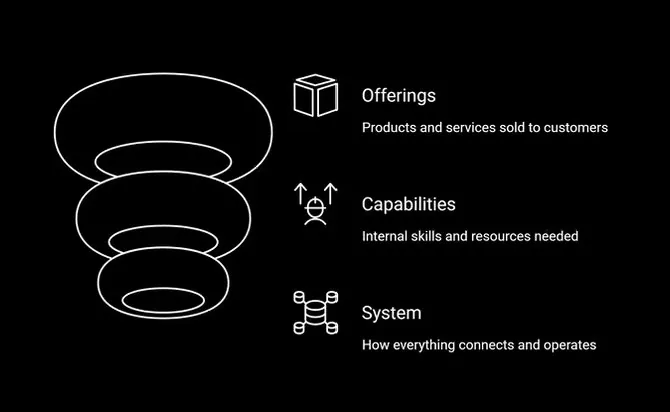
To scale execution without chaos, you need clarity across three core layers.
Here’s the model:
Layer | Purpose | What breaks when it’s off |
Vision | Sets direction and focus | Teams chase noise, not strategy |
Capabilities | Defines roles, ownership, and functional scope | Gaps, overlaps, and blurred accountability |
Systems | Moves work forward with rhythm and structure | Repetition, decision debt, inconsistent delivery |
Each layer exists by default.
But if they evolve without coordination, they start working against each other.
What’s the real problem?
It’s not that you’re missing these layers.
It’s that they grew organically, and now they don’t reinforce each other.
They were shaped by early hires, past pressure, and quick fixes.
Not by design.
They conflict. Or leave gaps. Or make the founder the glue.
That’s what actually breaks execution.
What misalignment feels like
You’re likely dealing with this if:
- Your team asks for clarity, but you thought it was obvious
- Projects start well but stall before completion
- Team leads don’t own the outcome, they escalate or wait
- The same decisions get revisited in every meeting
- Priorities shift too often or aren’t followed through
- Internal ops solves short-term issues but lacks long-term clarity
- You’re needed in day-to-day decisions that shouldn’t reach you
This is what misalignment looks like in practice.
You don’t need a new tool.
You need to realign the layers already in place.
Why this model matters
This isn’t a “framework.” It’s a map.
It helps you locate the real friction, not just treat symptoms.
- If you keep revisiting the same problems, your Vision layer isn’t clear enough.
- If people aren’t owning outcomes, the Capability layer requires redesign.
- If work feels scattered or reactive, your System layer is missing structure.
When these layers align, execution feels smooth.
When they don’t, you carry the cost, with your time, attention, and momentum.
How to spot where the problem lives
Start by asking:
- Is your vision used as a filter for decisions and resourcing?
- Do you have clear ownership across strategic functions?
- Is there a consistent rhythm for turning priorities into outcomes?
If you’re unclear on any of these, execution will feel heavier than it should.
How we use the model
We use the three-layer execution model as a lens, not a deliverable.
It helps us identify where systems are underbuilt, overloaded, or missing entirely.
Once we spot the friction, we design and implement the internal systems that create clarity, flow, and execution leverage.
Depending on where the pain sits:
- The Chief of Staff sprint clears friction in how priorities move and who owns them
- The Office of the CEO (CEO) builds structure around the leadership function
- The Enterprise System Architect service goes deeper: designing the full execution structure, focusing on the system layer
The model helps locate the problem.
System design solves it.
Want to fix the right layer?
If execution is dragging, even with a capable team and clear strategy, the issue is structural.
Let's design the internal systems your company actually needs to scale without chaos.
Start with the Decision Diagnosis →
It’s the fastest way to surface misalignment and start building clarity into how your company runs.
The next piece: follow on LinkedIn, or the RSS feed.