 LBM
A stalled rollout is usually not a sign that AI does not work for you. It is the normal first phase of any new general-purpose technology, and the research on it is clear: the return comes from the work around the tool, not from the tool. Fix one workflow before you touch the tool: give it an owner and a result, settle which numbers are right, capture what your experienced people know, and agree who checks the output. That base is what turns licences into results.
The licences are bought, the training happened, a few enthusiasts love it. And when you ask what changed in the numbers, the room goes quiet. You are not alone, and you are not late. You are standing exactly where every company stood with every technology of this kind.
Is a stalled rollout a sign AI does not work for us?
No. It is what the first years of a general-purpose technology look like.
The economic historian Paul David showed it with electricity. When factories electrified, many simply put a large electric motor where the steam engine had stood and kept the same long drive shafts, the same rows of machines and the same multi-storey buildings. In his classic paper The Dynamo and the Computer (American Economic Review, 1990), David found that electrification had no measurable impact on manufacturing productivity before the early 1920s, four decades after the first central power station opened. The gains came when factories gave each machine its own motor and redesigned the layout around the flow of work, often on one floor.

Modern economics has a name for the pause. Erik Brynjolfsson, Daniel Rock and Chad Syverson call it the productivity J-curve (American Economic Journal: Macroeconomics, 2021): technologies like AI need large complementary investments, mostly invisible ones such as new processes, data and skills, so measured productivity looks flat or worse before it rises.
The newest data shows the same shape for AI itself. Using US Census data on tens of thousands of manufacturing plants, Kristina McElheran and colleagues found that adopting AI was followed by a short-run drop in productivity, concentrated in older, established plants. Roughly half of that loss came from plants letting their structured management practices slip, and plants that already tracked their key numbers and targets did better (NBER conference paper, 2025).
So the question is not whether AI works. It is whether anyone is building the part that makes it pay.
What did the licences and the training actually buy?
Less than it feels like. The best evidence comes from Denmark, where Anders Humlum and Emilie Vestergaard linked a survey of 25,000 workers in 7,000 workplaces to official earnings records (NBER working paper 33777, 2025). Chatbots were widely used, but the typical time saving was around 2.8%, and they found no measurable effect on earnings or hours. Their finding that matters most for a stalled rollout: training and enterprise tools on their own did little to change daily use. The effect was substantially larger when companies combined tools and training with clear encouragement from the business to use them.
In other words, a licence and a training afternoon buy access. They do not buy a different way of working.
What does AI actually need from your company?
Four things, and each one is backed by careful research.
| What the research shows | What it means in your company |
|---|---|
| The gains came when work was redesigned around the new power source (David, 1990) | One workflow laid out again around AI, with an owner and a result, not AI added to the old steps |
| AI spreads the best practices of your most able people (Brynjolfsson, Li, Raymond, 2025) | What your experienced people know, kept where AI can read it |
| AI makes good people wrong outside the tasks it handles well (Dell'Acqua et al., 2023) | A person who knows where that line is, checking by an agreed rule |
| Plants that kept tracking their numbers came through the dip better (McElheran et al., 2025) | One right number, from one source, that everyone uses |
What your best people know. In the largest field study of generative AI at work, Brynjolfsson, Danielle Li and Lindsey Raymond followed 5,172 customer support agents (Quarterly Journal of Economics, 2025). Issues resolved per hour rose by 15% on average, the less experienced agents gained most, and the authors found that the tool spread the best practices of the most able agents to everyone else. That is the point most rollouts miss: AI multiplies know-how that is already captured somewhere it can learn from. Anthropic, which builds the Claude models, reaches the same conclusion from the other side: its Economic Index finds that access to the right context is a key bottleneck for businesses (2025). When the know-how lives in two people's heads, there is nothing for the model to spread.
A person who knows where the line is. In a pre-registered experiment with 758 consultants, Fabrizio Dell'Acqua and colleagues found that on tasks AI handles well, people using it finished 12.2% more tasks, 25.1% faster, at more than 40% higher quality. On a task just outside that range, the same people were 19 percentage points less likely to get the right answer (Harvard Business School working paper, 2023). The researchers call it the jagged frontier. Somebody in your company has to know where it runs for each workflow, and check accordingly.
One right number. When figures differ between systems, AI picks one and states it with confidence. The plants in McElheran's study that tracked their key numbers and targets were the ones that came through.
An owner and a result. Every one of these needs a person in the business who decides, which is why the owner comes first.
What does it look like in a real company?
In one company, the board pack, the budget and the sales system each showed a different recurring revenue figure, and AI-written reports kept contradicting each other. The model was fine; it repeated whichever figure it found first. The fix was not a new tool. It was one sheet with each measure, its method, its owner and its source, with the finance lead choosing which meaning is reported, and a simple guard that stops any outgoing figure not found in the finance register.

What do we fix first?
One workflow, end to end, where the cost of delay is visible: month-end close, customer questions, quotes or invoice matching. Build the base for that one workflow, in this order:
- An owner and a result. One person in the business and one number that should move.
- The right numbers. Where AI and finance disagree, finance's figure counts, and AI reads the same source.
- What your people know. The questions your most experienced colleagues answer every week, kept where AI can read them.
- The check. What a person reviews, by which rule, before anything leaves the building.
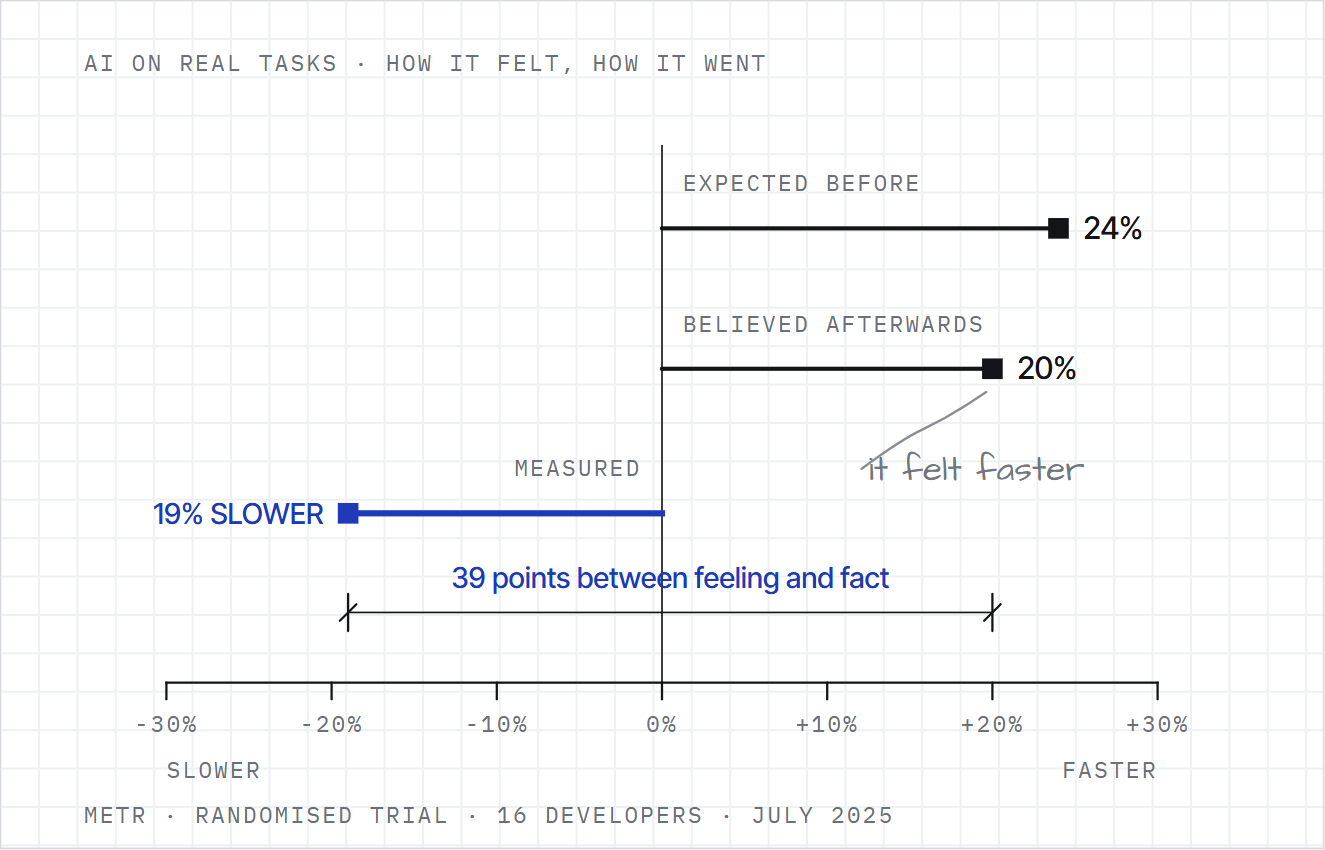
- A measurement. The workflow measured before and after. In a randomised trial by METR, experienced developers believed AI had made them 20% faster when it had made them 19% slower (2025). Only a number settles it.
Keep the tools you have while you do this. A new tool on the same workflow gives the same result. This is the work behind the AI and process page: the base comes first, built with your team, on the tools you already pay for. The same base is what later lets agents work safely, covered in is your company ready for AI agents?
And your people?
One more part deserves its own post: whether your employees take AI into their daily work. The Danish study found that clear encouragement from the business raised use far more than training alone, and that the benefits were greatest when encouragement, tools and training came together. A workflow that is ready, with a clear result and an owner, gives people a reason to trust the tool and a place to put the time it frees. A full post on employee adoption is coming.
Questions people ask about a stalled AI rollout
Is it the AI model?
Rarely. Studies from electrification to today's AI point the same way: the return depends on redesigned work, captured know-how and tracked numbers. The model is usually capable; what it was given is not ready yet.
How long until we see results?
The J-curve research suggests a dip before the gains, because the complementary work comes first. On one workflow with an owner, settled numbers and a check, a difference can show within weeks; across the company it takes longer.
Should we switch AI vendors?
Not until one workflow is ready. A new vendor meets the same missing owner, the same conflicting figures and the same scattered know-how, and you pay for the switch twice.
Who should own AI in the business?
The person who owns the workflow it serves, not IT alone. IT runs the tool; the business owns the result, the exceptions and the check.
Talk it through
If your rollout stalled and you want a second view on where to start, book a free 15 minute intro call. It is a conversation, person to person, not a pitch. If it needs a closer look, the Decision Diagnosis is an optional first step, and the AI readiness check shows in seven questions where your rollout stands.
Sources
- Paul A. David, The Dynamo and the Computer: An Historical Perspective on the Modern Productivity Paradox, American Economic Review Papers and Proceedings 80(2), 1990.
- Erik Brynjolfsson, Daniel Rock, Chad Syverson, The Productivity J-Curve, American Economic Journal: Macroeconomics 13(1), 2021.
- Kristina McElheran and colleagues, The Rise of Industrial AI in America: Microfoundations of the Productivity J-curve(s), preliminary NBER conference paper, July 2025. US Census data on manufacturing plants.
- Anders Humlum, Emilie Vestergaard, Large Language Models, Small Labor Market Effects, NBER working paper 33777, 2025. 25,000 workers in Denmark.
- Erik Brynjolfsson, Danielle Li, Lindsey Raymond, Generative AI at Work, Quarterly Journal of Economics 140(2), 2025. 5,172 customer support agents.
- Fabrizio Dell'Acqua and colleagues, Navigating the Jagged Technological Frontier, Harvard Business School working paper 24-013, 2023. 758 consultants.
- METR, Measuring the impact of early-2025 AI on experienced open-source developer productivity, randomised controlled trial, July 2025.
- Anthropic, Economic Index: Uneven AI adoption, September 2025.
The next piece: follow on LinkedIn, or the RSS feed.