 LBM
Business succession planning: what Vietnam's decade of handovers teaches every founder-led company
Choose the successor on ability, start years before the handover, and turn what the founder carries into something the company can keep. The research on family succession is unusually consistent: when value is lost, most of it goes before the successor takes over, and it goes fastest where the company depends on one person's relationships and judgement. Vietnam is about to test this on a whole generation at once.
Why is Vietnam facing a decade of succession?
Vietnam's private sector is young. Almost all of it was built after the Doi Moi reforms of 1986, by founders who started in their late twenties and thirties. As the businessman Nguyen Tien Huy argues in a recent essay for VnExpress (November 2026), that generation is reaching its sixties and seventies at roughly the same time. Japan and Europe hand over companies a few at a time, across decades. Vietnam is about to do it all at once, and for most families for the first time: very few of today's founders were ever successors themselves.
The stakes are national. Vietnam's private economy contributes about 50% of GDP, more than 30% of state budget revenue and about 82% of all jobs, and the government's Resolution 68 aims for two million businesses by 2030. And the preparation is thin: in PwC's 2023 survey of Vietnamese family businesses, only 28% had a family constitution or protocol and only 25% had a way to resolve conflicts.
One honest note before the evidence: there is no rigorous quantitative study yet of succession and performance in Vietnamese firms. The hard evidence comes from Denmark, the United States, Japan and Chinese family firms in Hong Kong, Taiwan and Singapore. It is remarkably consistent, which is why it is worth learning from before Vietnam produces its own.
Is this only a Vietnamese problem?
No. Vietnam is where it is happening fastest. The same pattern shows up wherever a generation built companies around themselves.
| Where | What the data shows | Source |
|---|---|---|
| Japan | 49.2% of about 280,000 companies have no successor or have not decided on one, the first year below half after nine years of slow improvement. | Teikoku Databank, November 2026 |
| Germany | About 114,000 Mittelstand companies a year plan to close when the senior generation leaves, against about 109,000 seeking a successor, every year to 2029. | KfW Research, January 2026 |
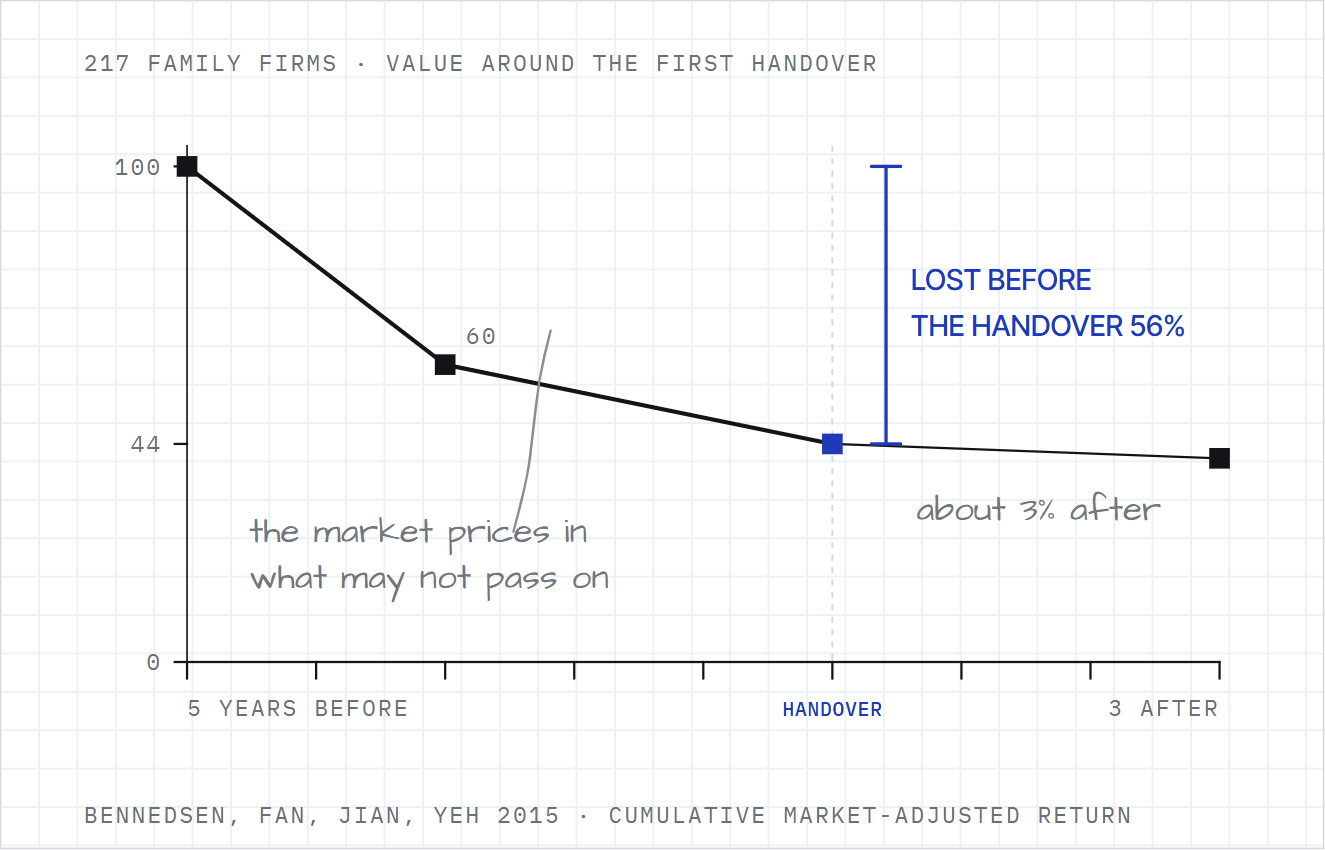
| Hong Kong, Taiwan, Singapore | 217 family firms lost 56% of market-adjusted value in the five years before the handover, and 2.9% in the years after. | Bennedsen, Fan, Jian and Yeh, 2015 |
| Vietnam | A whole first generation of founders handing over within one decade, most without written family arrangements. | PwC Vietnam 2023; VnExpress 2026 |
What does the research say goes wrong?
Three of the best-known studies in economics point the same way, and none of them says family successors are worse people. They say the default rule is costly.
Denmark. Morten Bennedsen, Kasper Nielsen, Francisco Pérez-González and Daniel Wolfenzon studied 5,334 CEO successions in Danish companies between 1994 and 2002 (Quarterly Journal of Economics, 2007). When the top job went to a family member, operating return on assets fell by at least four percentage points around the handover. To separate cause from coincidence, they used the gender of the departing CEO's first child: when it was a boy, the job went to family far more often (39% against 29%), and performance suffered accordingly. The damage was largest in fast-growing and skill-heavy industries.
The United States. Francisco Pérez-González found the same in listed American firms (American Economic Review, 2006): firms that appointed a family heir underperformed those that promoted an unrelated CEO, and the gap was concentrated among heirs who had not attended a selective college.
Management itself. Nicholas Bloom and John Van Reenen scored the management practices of 732 manufacturers in the US, UK, France and Germany (Quarterly Journal of Economics, 2007). Family ownership on its own was not the problem; with professional managers it was mildly positive. The badly managed tail was driven by family firms that handed control to the eldest son by default.
The lesson is not "never choose family". It is: decide on ability, compared openly with other candidates, not by birth order.
Why is so much value lost before the handover?
Because what makes a founder-led company valuable often lives in the founder. Morten Bennedsen, Joseph Fan and colleagues followed 217 successions in Hong Kong, Taiwan and Singapore (Journal of Corporate Finance, 2015). Market-adjusted value fell 56% over the five years before the handover year, 16% of it in the last three, and only 2.9% in the years after. The losses were larger when the outgoing chairman was the founder, when the business was co-founded, and when more relatives managed it together. Successor experience reduced them.
A companion study by Fan and colleagues explains why (Hitotsubashi working paper, 2009): assets specific to the founder, such as reputation and personal and political networks, dissipate at the handover. Markets see that coming, years ahead, and price it in.
That makes the real succession question practical: which of the company's relationships, decisions and know-how exist only in one person, and how do they become the company's before the founder steps back?
What did Japan's oldest family firms learn?
Japan has more century-old companies than any other country, and one of its tools is unusual: when no son is suitable, families adopt an adult successor, often a talented manager, sometimes a son-in-law. Vikas Mehrotra, Randall Morck, Jungwook Shim and Yupana Wiwattanakantang studied nearly every listed non-financial Japanese firm from 1962 to 2000 (Journal of Financial Economics, 2013). Firms run by adopted heirs outperformed those run by blood heirs and roughly matched founder-run firms. Part of the reason, the authors argue, is that the seat was contestable: managers had a reason to prepare, and blood heirs knew they could be passed over.
Few families will adopt. But the principle travels: a seat that has to be earned produces better successors than a seat that is inherited by default.
What has to be in place before the handover?
The legal pieces matter, and your lawyers and advisers own them: shareholder agreements, wills, a family constitution. What usually goes missing is the layer between those documents and daily work: how the companies actually decide and report. The research above suggests what it has to do: make the founder-specific assets visible and shareable, and let the successor be tested on real responsibility.
- The map. Every company, holding, adviser and family member, and how decisions and information really move between them today, including the relationships that run only through the founder.
- Who decides what. What the family decides, what each CEO decides inside clear limits, and what advisers handle inside a mandate.
- The reasoning behind the big calls. Why the founder says yes or no, what they protect, which trade-offs they accept: the know-how that otherwise leaves with them.
- The one page. A view of the whole that the family can read, the same day each month, so the successor learns the whole before running a part.
- The succession path. Seats taken one at a time, each with real limits and a real chance to fail.
The test is simple: if the founder were away for three months, would the family know what it owns, what is decided, and who to ask? This is the work behind the family business and family office page.
How should the next generation take over?
Seat by seat, with real responsibility early. A qualitative study of Vietnamese father-and-son successions by Pham, Bell and Newton (Journal of Entrepreneurship in Emerging Economies, 2019) describes the founder moving through roles: first an example, then a supporter of the successor's study and work outside the family firm, then a mentor, and finally an adviser once the successor leads. Vietnamese history has the same shape at the top of the state: under the Tran dynasty, the emperor stepped back while still healthy and advised his successor.
In practice, the next generation runs one company inside clear limits while the founder is still there to explain the relationships and the reasoning. Each part carried well widens the limits. It is the same idea as moving one decision loop at a time off the desk in a founder-led company, applied across a generation.

When should you start?
Earlier than feels necessary. The evidence says the value moves years before the handover, so start now if:
- The founder is over sixty and no date or successor has been named
- The next generation works in the business but has never run a part of it alone
- Customers, banks or key staff deal with one person for every important matter
- Family members disagree about the future, or quietly avoid the subject
- Several companies report in different formats, so nobody sees the whole
Questions families ask about business succession
When should business succession planning start?
Years before the handover. In the study of 217 Asian family firms, most of the value loss happened in the five years before the successor took over, so preparation that starts at the handover starts too late.
Should the successor be a family member?
Possibly, if chosen on ability. Large studies in Denmark and the US found that defaulting to family heirs cost profitability, while Japan's adopted heirs and family firms with professional managers did well. Compare candidates openly.
Why do family businesses lose value at succession?
Much of their value sits in the founder: relationships, reputation and judgement. If those are not made the company's own before the handover, markets expect them to leave with the founder and price that in.
What if no one in the family wants to take over?
Then the same groundwork matters even more. A company that runs without one person at the centre can be led by a professional CEO, sold at a fair price, or handed to a later generation. One that cannot often closes, as Germany's figures show.
Talk it through
If a handover is coming in your family's companies, book a free 15 minute intro call. It is a conversation, person to person, about what the next generation would inherit and what has to be in place first. Not a pitch. If it needs a closer look, the Decision Diagnosis is an optional first step.
Sources
- Morten Bennedsen, Kasper Nielsen, Francisco Pérez-González, Daniel Wolfenzon, Inside the Family Firm: The Role of Families in Succession Decisions and Performance, Quarterly Journal of Economics 122(2), 2007. 5,334 Danish successions.
- Francisco Pérez-González, Inherited Control and Firm Performance, American Economic Review 96(5), 2006.
- Nicholas Bloom, John Van Reenen, Measuring and Explaining Management Practices Across Firms and Countries, Quarterly Journal of Economics 122(4), 2007. 732 manufacturers.
- Morten Bennedsen, Joseph Fan, Jian, Yeh, The Family Business Map, Journal of Corporate Finance 33, 2015. 217 successions in Hong Kong, Taiwan and Singapore.
- Fan, Wong, Zhang, Founder Succession and Accounting Properties, Hitotsubashi working paper, 2009.
- Vikas Mehrotra, Randall Morck, Jungwook Shim, Yupana Wiwattanakantang, Adoptive Expectations: Rising Sons in Japanese Family Firms, Journal of Financial Economics 108(3), 2013.
- Pham, Bell, Newton, study of father-and-son successions in Vietnamese family businesses, Journal of Entrepreneurship in Emerging Economies 11(2), 2019 (author post-print).
- Teikoku Databank, national survey of companies without a successor, 2026, 20 November 2026 (in Japanese).
- KfW Research, Nachfolge-Monitoring Mittelstand 2025, January 2026 (in German).
- PwC Vietnam, Family Business Survey 2023, 2023.
- Hai Phong Department of Finance, Resolution 68-NQ/TW on private economic development, Vietnamese government page.
- Nguyen Tien Huy, Vietnam's decade of business succession has begun, VnExpress International, 21 November 2026. Opinion piece.
The next piece: follow on LinkedIn, or the RSS feed.