 LBM
Everything still goes through you? How founder-led companies get their speed back
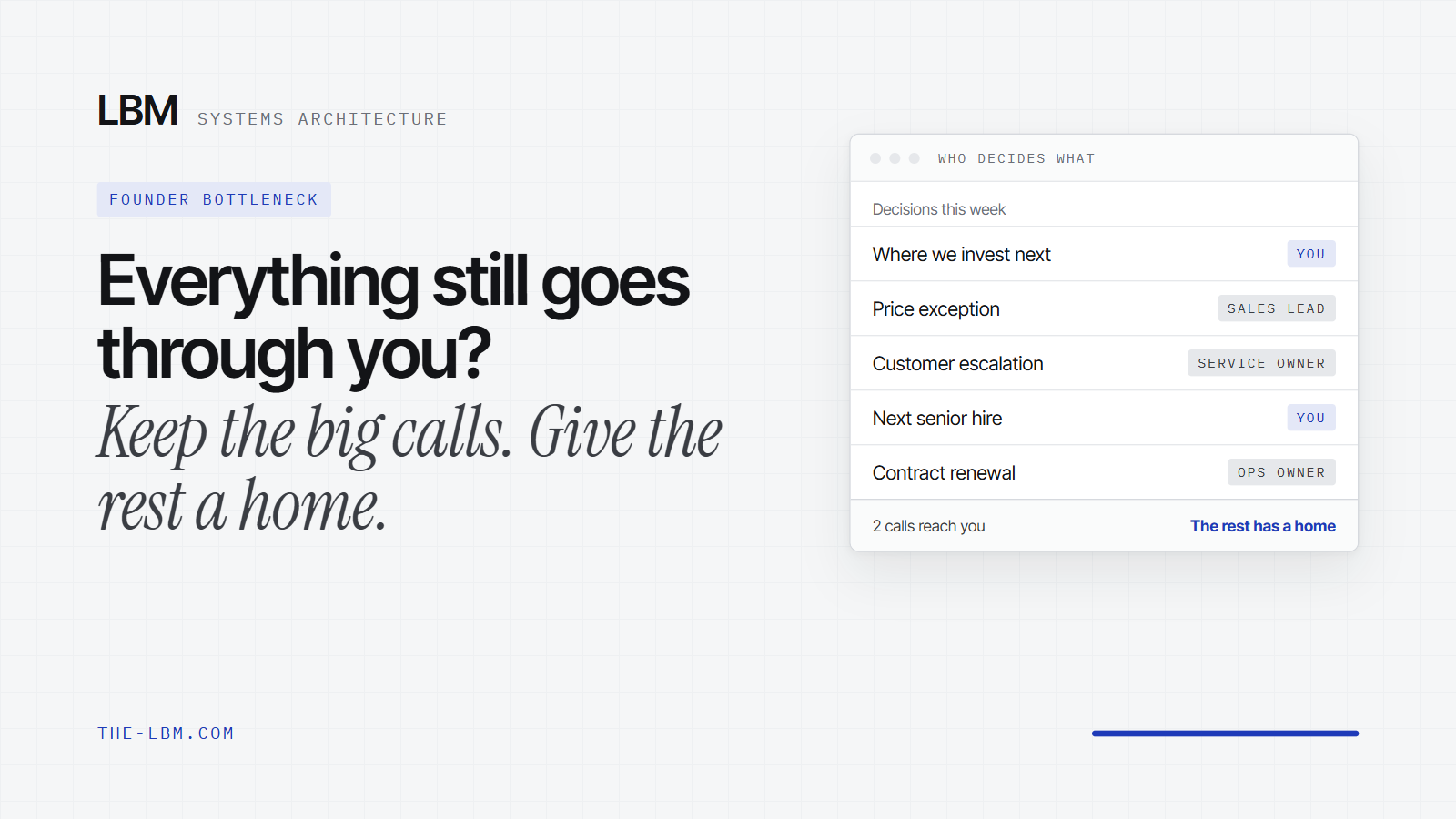
Because the company has grown past the way it was set up to decide. In a small team, everything going through the founder is fast. Past thirty or forty people, it becomes the queue everyone waits in. You get the speed back by deciding which calls stay with you, giving every recurring workflow one owner, sharing the reasoning behind your calls, and running a weekly rhythm. You keep the big calls. The rest gets a home.
You hired good people. The product moves. Revenue is real. And yet every week more questions land on your desk, not fewer, and things slow down when you are away.
This is not a sign that you are bad at letting go, and it is not your team's fault. It is what growth does to a company that was built, very successfully, around one person's judgement.
Why does a founder-led company slow down as it grows?
In a ten-person team, context is free. Everyone hears everything, and decisions move because the room knows what matters.
Then the company grows, and the number of conversations needed to keep everyone aligned grows much faster than the headcount. Ten people have 45 possible one-to-one lines between them. Fifty people have 1,225. Nobody can carry that many, so the lines quietly run through the one person who sees the whole picture: you.
From the inside it looks like this:
- People hesitate, because it is not clear what they may decide
- Decisions come back to you, because the trade-offs live in your head
- Projects wait between teams, because nobody owns the whole flow
- You become the link between every function
None of it shows on a dashboard. It shows up as longer cycle times, more meetings, and the feeling that the company needs you in more places than before.
It is a well-studied pattern. Bain found that only one in nine companies sustains profitable growth for ten years or more, and that 85% of the problems leaders cite are internal (Bain, June 2016). Their phrase for it: growth creates complexity, and complexity kills growth. It is the same pattern described in why execution breaks after product-market fit: what got you here now has to carry more.
Is "founder mode" the answer?
Partly, and it is worth taking seriously. In Founder Mode (September 2024), Paul Graham describes how Airbnb's founder was advised to "hire good people and give them room to do their jobs", followed the advice, and found the results "disastrous". Many founders recognised themselves. Stepping back completely is not the answer, and you should not be asked to.
But Graham also writes that founders cannot keep running a 2,000-person company the way they ran it at 20, and that there will have to be some amount of delegation. The real question is not whether you stay involved. It is which decisions stay with you, and how everything else moves without waiting for you.
Which decisions should stay with you?
Jeff Bezos drew the most useful line in his 2015 letter to Amazon shareholders. Some decisions are one-way doors: hard or impossible to reverse, so they deserve care and the most senior judgement. Most are two-way doors: if they turn out wrong, you walk back through. Those, he wrote, should be made quickly by people with good judgement close to the work. As companies grow, they tend to treat every decision like a one-way door, and everything slows.
In one company I run, the line became a short written rule. A decision comes to the owners only if it spends money, commits someone outside the company, cannot be undone, pulls attention from another project, changes what a customer sees, or changes a rule. Everything else is decided where the work happens, and what does come up arrives as one card with the options, the cost, a recommendation and a default. The owners now answer a few cards a week instead of questions all day. That case and others are on the cases page.
What has to be in place for decisions to stop waiting on you?
Four parts, together. Any one of them alone fades within weeks.
| Part | What it answers | What you feel without it |
|---|---|---|
| Who decides what | Which calls stay with you, which need a check-in, which the team makes | Every question finds your desk |
| The reasoning behind your calls | What you optimise for, what you say no to, which trade-offs you accept | The team does the task but misses the intent |
| One owner per recurring workflow | Who carries each flow from start to finish | You become the person who follows everything up |
| A weekly rhythm | When commitments are checked and drift shows up | You find out at the quarterly review |
Who decides what comes first, because it removes the most interruptions. When it is not clear, the safe guess for anyone is to ask you.
The reasoning behind your calls is the part founders skip. Your team can follow a decision. What they cannot do is rebuild the reasoning behind it. Sharing why you say no, and which trade-offs you accept, is what lets people decide the way you would.
One owner per recurring workflow means a name for the whole flow, not for each task. GitLab, which runs much of its company from a public handbook, calls this the directly responsible individual: one person with the final say, who consults widely but leaves no doubt about who decides. When a workflow has no owner, it has you.
A weekly rhythm keeps the other three alive. Without a fixed moment where commitments are checked, the lines blur and work drifts back to your desk.
Put together, this is what an Office of the CEO is: the structure around the person who decides, so you keep the big calls and the rest has a home.
Does hiring a Chief of Staff or a COO fix it?
It can, and often it is the fastest fix. What decides the outcome is what the person has to work with. A senior hire who arrives into clear lines on who decides what can take whole areas off your desk within weeks. One who arrives without them often ends up routing questions back to you, because there is no other answer to give.
That is why there are two ways in. A Chief of Staff in the seat is the fix for now: someone who gets stuck work moving and starts building the lines as they go. The structure around you is the fix for good. The difference between an Office of the CEO and a Chief of Staff is exactly this: one is a role, the other is the structure the role works in.
Where do you start?
Not with a company-wide programme. Pick one recurring loop that interrupts you every week and take it off your desk completely. One loop, fully moved, teaches the company more than a hundred pages of documentation.
Common first loops:
- Pricing approvals and exceptions
- Customer escalations
- Hiring for roles below the leadership team
- Contract sign-offs
- Product priority calls
For that one loop, agree who decides, share the reasoning, name the owner, and add it to the weekly rhythm. Then stay out of it, even when you would have decided slightly differently. The second loop is easier than the first, because the team has seen what good looks like without you in the room.
When is it time to act?
- Your calendar is full of catch-up meetings, not decision meetings
- Your best people deliver through extra effort, not through a system that carries them
- Senior hires have not given you time back
- Projects stall where one team hands work to the next
- Strategy is clear, but execution drifts within weeks of any plan
If two or more apply, the five-question check shows whether a Chief of Staff or the structure around you would help more.
Questions founders ask about the founder bottleneck
What is a founder bottleneck?
The point where a growing company's decisions queue up behind its founder. It is usually not about the founder's ability. The company has grown past the stage where one person could see and decide everything, and nothing else has taken over that job yet.
Is founder mode the opposite of delegating?
No. Paul Graham's essay argues against handing the company to managers and stepping away, but also says a large company cannot be run the way it was at 20 people. The useful version: you stay close to the work and keep the one-way decisions, and everything else has a clear owner.
Which decisions should a founder keep?
The ones that are hard to undo, spend real money, commit someone outside the company, change what customers see, or change a rule. Reversible, everyday decisions are usually better made quickly by the people closest to the work.
How long does it take to stop being the bottleneck?
The first loop can come off your desk within weeks. The full structure grows one loop at a time, and each loop is easier than the last, because the team learns from the first what deciding without you looks like.
Should I hire a Chief of Staff or a COO first?
It depends on whether you need someone to move stuck work now or need the structure that lets every leader decide more. The Decision Diagnosis is an optional first step that shows which, on your real decisions.
Talk it through
If you recognise your company here, book a free 15 minute intro call. It is a conversation, person to person, about which loop costs you the most and what would have to change to move it off your desk. Not a pitch. If there is a clear place to start, we will both see it.
Sources
- Paul Graham, Founder Mode, essay, September 2024.
- Jeff Bezos, 2015 letter to Amazon shareholders, filed with the US SEC, April 2016.
- GitLab, Directly Responsible Individuals, GitLab Handbook, read 19 November 2026.
- Bain & Company, The Founder's Mentality: How to overcome the predictable crises of growth, 10 June 2016.
- The coordination arithmetic is the number of possible pairs in a group: n times (n minus 1), divided by 2.
The next piece: follow on LinkedIn, or the RSS feed.