 LBM
Common Traps When Building the Office of the CEO
You’ve realized the company can’t keep scaling around you.
You’re at capacity.
Strategic decisions are stuck.
And even though you’ve hired EA or added any other support, things haven’t gotten easier.
In some ways, they’ve gotten messier.
That’s usually the first sign.
You started hiring support, but skipped designing the system.
What the Office of the CEO actually is
The Office of the CEO isn’t a title or team.
It’s a designed internal operating unit that enables the CEO (or GM or Founder) to:
- Stay at altitude
- Focus on strategic direction
- Move decisions faster
- Lead with fewer bottlenecks
- Delegate without confusion
- Protect their context
It usually includes a tight unit of 2–4 roles:
- Chief of Staff → connects strategy and execution
- Executive Assistant → filters noise, protects time
- Strategic Partner or CSO → supports external moves (fundraising, M&A, partnerships)
- Optional: Comms Lead, Analyst, or BizOps → based on the CEO’s priorities and company goals
But what makes this work isn’t who’s in it.
It’s how they operate. As a system, not support.
Done right, the Office of the CEO becomes the execution rhythm behind leadership.
Done wrong, it adds motion but not clarity.
📖 What is the Office of the CEO?
📖 Enterprise System Architecture
📖 Is your company running on people or systems?
Confusing “help” with operating design
Hiring someone to “help the CEO” is not the same as designing how the CEO is supported.
The Office of the CEO must define:
- The CEO’s protected time
- What decisions they personally own
- What gets filtered, packaged, or delegated
- How priorities turn into motion internally
The goal isn’t help. It’s leverage by design.
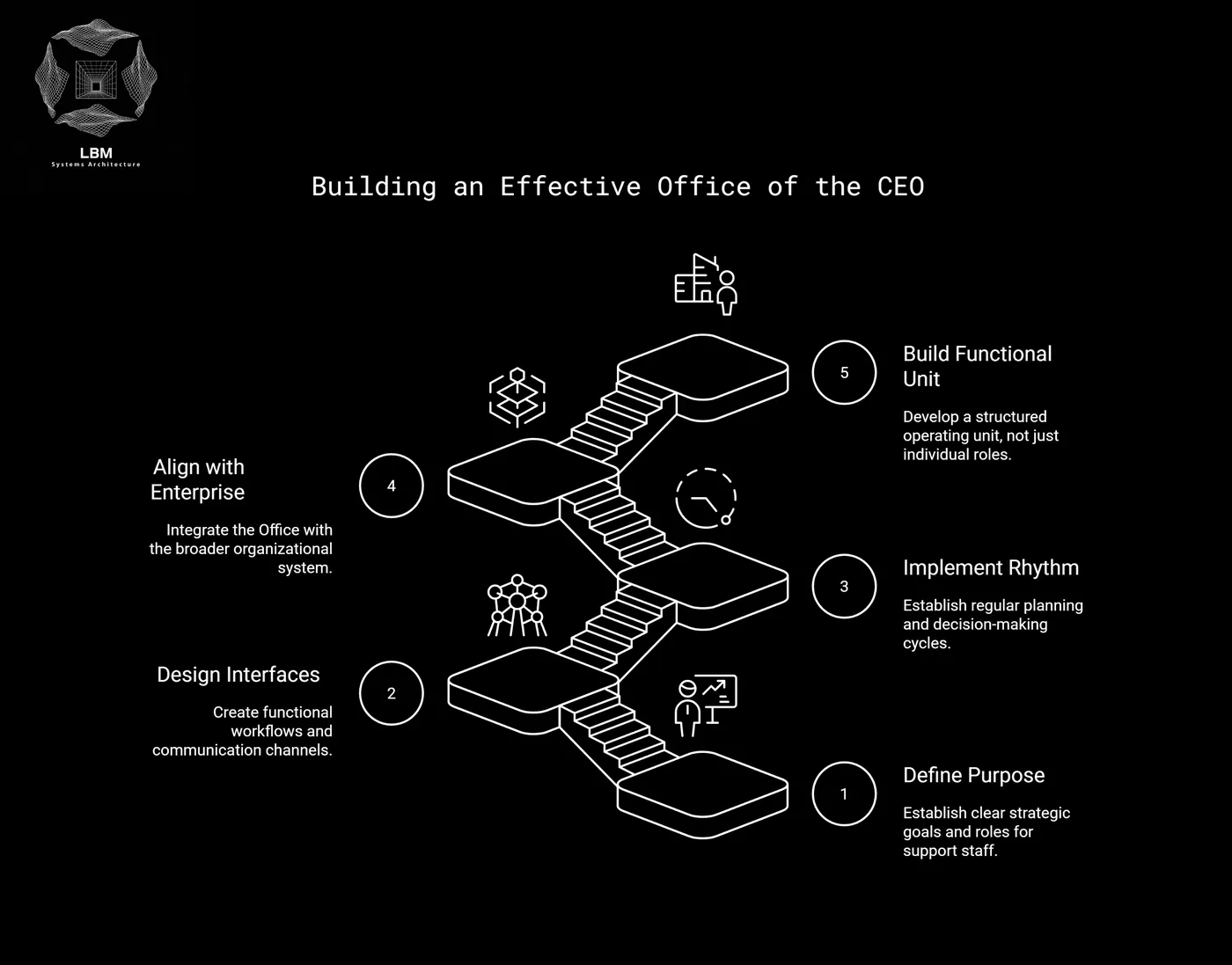
Here are common traps when building the Office of the CEO
Most traps come from trying to “support the CEO” without designing the support structure.
That leads to shallow improvements, and deeper misalignment.
1. Hiring before defining purpose
You add an Executive Assistant, a strategic role, or another form of support.
But you never define:
- What strategic decisions they support
- How they manage execution flow
- What meetings they drive or shape
- Where their influence starts and stops
What happens?
They drift into EA work, slide into PM territory, or become a proxy leader with no clarity.
They burn out, or create friction.
Fix: Always design the role inside a system, not as a standalone fix.
2. Over-indexing on access, not function
“Give them proximity to the CEO” becomes the plan.
But proximity ≠ leverage.
Without rhythm, structure, or boundaries, this leads to:
- More meetings, not better ones
- More escalation, not smarter delegation
- Constant requests to “check with the CEO”
Fix: Design functional interfaces and workflows that support, not depend on, the Principal (CEO, Founder, GM, Director).
3. No planning or execution rhythm
You install support roles, but don’t define:
- Weekly leadership rhythm
- Quarterly/annual planning logic
- Decision review cycles
- Executive syncs and prep
- Communication cadence
The result?
- Strategy keeps resetting
- Priorities compete, not align
- Internal ops becomes reactive
This is classic “unwanted” behaviour: repeatable but not scalable.
Fix: Make rhythm design part of the Office build, not an afterthought.
4. Assuming one hire solves all friction
You install support roles, but don’t build a planning or execution cadence around them.
What happens?
- Weekly meetings drift
- Quarterly planning resets every 6 weeks
- Leadership updates turn into status chaos
- No one knows what’s actually been decided
Support without rhythm is noise. Structure without cadence breaks under pressure.
Fix: Build the Office around systems, not personalities.
5. Building without aligning it to the enterprise system
If the Office of the CEO is disconnected from your Enterprise System Architecture, it breaks on impact.
You can’t:
- Plan in isolation from operations
- Make decisions with no data architecture
- Set goals with no prioritization logic
- Align leadership without structural feedback loops
The Office isn’t a silo.
It’s a control hub inside a broader system.
📖 Read: Enterprise System Architecture
📖 Read: What does a Systems Architect for business solve?
6. Treating the Office like a personal entourage
A Principal hires helpers instead of architects.
They think they need:
- A CoS to manage tasks
- An EA to buffer the chaos
- A strategy lead to “take things off their plate”
But none of it scales if it isn’t structured to operate together.
Fix: Design a functional operating unit, to not end up with a loose hires orbiting one overloaded person.
What to do instead
Build your system first, in order to avoid these common traps when building the office of the CEO.
That means:
- Mapping what the CEO needs to stay strategic
- Defining the cadence and workflows around them
- Installing key roles with ownership, not guesswork
- Creating a system where the CEO leads, without holding it all
This is exactly what we build during the Office of the CEO Sprint:
A design-first approach that installs your internal operating system and structures leverage around the role your company still depends on.
Book a free 15 minute intro call
The next piece: follow on LinkedIn, or the RSS feed.