 LBM
The Office of the CEO vs. Chief of Staff: What is the Real Difference?
You’re feeling the stretch.
Everyone pulls on your time.
You’re the one making key decisions, keeping leadership aligned, filling the gaps.
And now you’re trying to fix it.
Someone says, hire a Chief of Staff.
Someone else says build an Office of the CEO.
But what do these actually mean?
What’s the difference, and which one do you need?
The Office of the CEO is a system
The Chief of Staff is a role inside it.
Most companies confuse the two.
They hire a CoS thinking the system will follow.
It doesn’t.
A Chief of Staff gives you leverage.
The Office of the CEO gives you structure.
If you're serious about scaling yourself, this difference matters.
Read also about:
📖 Signs your business needs an Office of the CEO
📖 Common traps when building the Office of the CEO
📖 Chief of Staff vs COO vs Fractional Exec: How to choose
📖 Enterprise System Architecture
📖 Is your business running on people or systems?
Why this confusion happens
Because both start at the same pain:
- The CEO is overloaded
- Leadership lacks sync
- Strategic priorities aren’t driving execution
- The business is scaling faster than internal clarity
And both CoS + OoC feel like the answer.
But they solve different layers of the problem.
So, what is the difference between chief of staff and office of the ceo?
Side-by-side: Chief of Staff (CoS) vs. Office of the CEO (OoC)
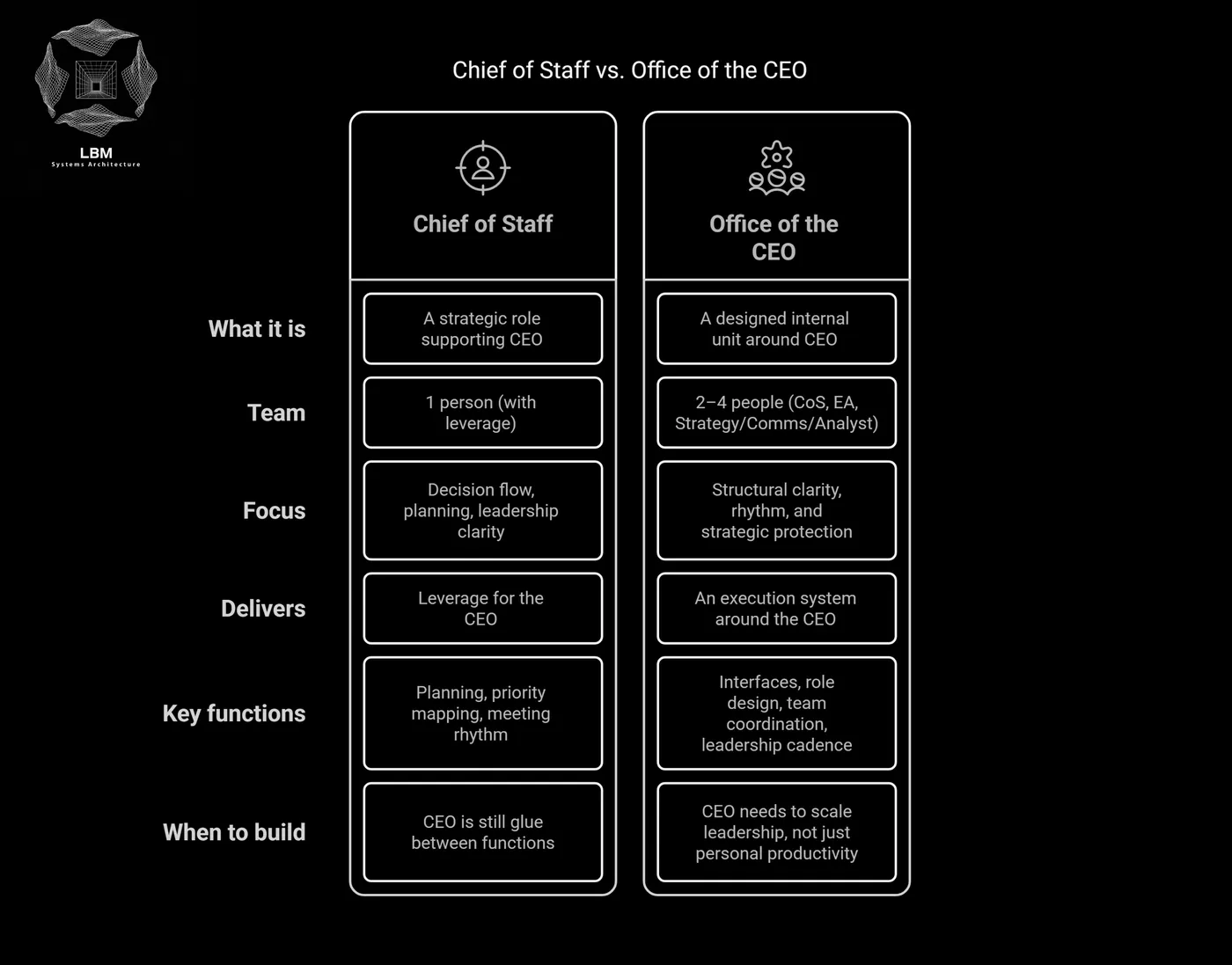
Chief of Staff | Office of the CEO | |
What it is | A strategic role supporting the CEO | A designed internal unit built around the CEO |
Team | 1 person (with leverage) | 2–4 people (CoS, EA, Strategy/Comms/Analyst) |
Focus | Decision flow, planning, leadership clarity | Structural clarity, rhythm, and strategic protection |
Delivers | Leverage for the CEO | An execution system around the CEO |
Key functions | Planning, priority mapping, meeting rhythm | Interfaces, role design, team coordination, leadership cadence |
When to build | CEO is still glue between functions | CEO needs to scale leadership, not just personal productivity |
What happens when you hire a Chief of Staff, but skip the system?
You get motion, but no reinforcement.
- Decisions still flow through you
- Context lives in your head
- Planning resets constantly
- Meetings are heavy, not aligned
- Strategy floats, but doesn’t cascade
It’s not the CoS’s fault.
It’s because you’ve hired someone into an undefined system.
📖 Is your company running on people or systems?
The Office is a platform, not a person
Think of the Office of the CEO as your internal leverage stack.
It aligns the roles and routines that:
- Filter noise
- Move decisions
- Sequence priorities
- Push execution
- Keep leadership coordinated
The Chief of Staff helps lead this, but can’t replace it.
If you're serious about protecting the CEO’s altitude and scaling the business without more chaos, you don’t just hire support, you design a system.
When to start with a CoS?
Start here when:
- You still personally manage strategy → ops handoffs
- You’re in most team syncs
- You’re still writing board decks yourself
- You’re overloaded with internal questions
A CoS can reduce drag.
But don’t expect them to design the full structure.
Start with a Chief of Staff to:
- Audit where friction is happening
- Set up decision loops and planning rhythm
- Define internal execution cadence
- Free up your mental bandwidth
When to build the full Office of the CEO?
Move here when:
- Strategy and ops feel disconnected
- Context doesn't travel across leadership
- You’ve hired support—but still make every critical call
- Internal velocity is inconsistent or reactive
- You're already holding multiple priorities at once (growth, fundraising, M&A, etc.)
This is where we build the Office of the CEO.
A real execution layer around your leadership.
That includes:
- Defining who supports what
- Designing priority flow and rhythm
- Interfacing with key functions (ops, finance, product, comms)
- Creating decision velocity at the top
Book a free 15 minute intro call
The next piece: follow on LinkedIn, or the RSS feed.